

3 Refrigerant Ventless AC Types for Smart Homes and Rowan ZAFRO Picks
Noko editorial teamA ventless air conditioner is a refrigerant-based cooling system, whether a mini-split, through-the-wall unit, or hoseless portable model, that cools a room without a window vent. It’s the right pick for sealed-window apartments, rooms with no usable window, or anyone who wants permanent, efficient cooling with smart-home control. Get the sizing and installation right, and it will outperform almost anything else you can plug in.
TL;DR:
- Proper sizing is crucial, as oversizing leads to rapid cooling but poor humidity removal, leaving rooms feeling damp despite being cold.
- Inverter compressors provide steadier operation and more efficient humidity control, even if sizing mistakes are made, but correct sizing remains essential.
- Professional installation ensures proper sealing, refrigerant charging, and adherence to line-length limits, which is vital to prevent long-term moisture and performance issues.
- Efficiency ratings like SEER and EER, along with refrigerant types, influence ongoing costs and environmental impact, with newer models shifting toward lower-GWP refrigerants.
- Smart-home features such as Wi-Fi control, scheduling, and voice compatibility add value but vary in reliability depending on whether built-in or external controllers are used.
Table of Contents
- Rowan Appliance Ventless Options at a Glance
- How Refrigerant Ventless Systems Actually Cool a Room
- Sizing and Humidity: Getting Capacity Right
- Installation Considerations and What Requires a Professional
- Efficiency, Refrigerants, and Longevity: What to Compare
- Smart-Home Integration and Controls
- Maintenance, Troubleshooting, and What It Costs to Run
- Quick Buying Checklist: Choosing the Right Ventless AC
- Author Perspective: When a Ventless Refrigerant System Is the Best Choice
- Where to Start: Rowan Appliance Ventless Models and Support
- Sources
- FAQ
Rowan Appliance Ventless Options at a Glance
A ventless air conditioner lineup can cover common room needs, and matching your room to the right one saves you from an oversized, humidity-dumping mismatch.
- ZAFRO EliteCool Air Conditioner: built for single mid-size rooms, with smart controls and a straightforward wall-mount or sleeve install.
- ZAFRO Bamboo EliteCool Air Conditioner: the same core cooling engine wrapped in a bamboo-finish cabinet, a good fit for living rooms where the unit stays in view.
- ZAFRO ComfortFlow Air Conditioner: designed for steadier, quieter airflow in bedrooms or home offices where noise matters more than raw capacity.
If you’re renting a studio with a sealed window, the EliteCool is your starting point. If the unit lives in a shared living space, the Bamboo EliteCool blends in better. For a bedroom where you sleep next to it, ComfortFlow’s quieter operation carries more weight than a few extra BTUs.
How Refrigerant Ventless Systems Actually Cool a Room
Every ventless refrigerant AC runs the same basic loop: a compressor pressurizes refrigerant gas, it releases heat outdoors as it condenses into liquid, then absorbs heat indoors as it evaporates back into gas. No moisture gets added to your air, unlike evaporative coolers. It just moves heat from inside to outside through a sealed line.
Three form factors qualify as ventless under this definition. Mini-splits put the compressor outdoors and an indoor air handler on the wall, connected by a slim refrigerant line. Through-the-wall units house everything in one chassis set into a wall sleeve, with the condenser coil facing outside. Refrigerant portable units sit on casters indoors and use a hoseless refrigerant loop rather than an exhaust duct, though these remain less common than the first two.

Inverter, or variable-speed, compressors change output on the fly instead of switching fully on and off. That steadier operation matters more than most buyers realize: it’s what makes a system pull moisture out of the air consistently rather than in short, ineffective bursts.
Sizing and Humidity: Getting Capacity Right
Bigger is not better here. A unit sized above your room’s actual cooling load cools the air fast, satisfies the thermostat, and shuts off before it has run long enough to pull real humidity out of the room. That leaves you with a space that reads “cold” on the thermostat but still feels clammy.
Pro Tip: If a room feels cool but sticky within minutes of the AC cycling off, that’s a classic sign of an oversized unit, not a broken one.
ENERGY STAR’s sizing guidance gives a useful baseline: roughly 5,000 BTU for 100 to 150 square feet, scaling up to about 14,000 BTU for 550 to 700 square feet, and around 18,000 BTU for 700 to 1,000 square feet. Adjust upward for a sun-facing room, high ceilings, or poor insulation, and downward for a shaded, well-insulated one.
Before you buy or request a quote, gather:
- Room square footage and ceiling height.
- Number and size of windows, and which direction they face.
- Insulation quality and any adjoining unconditioned spaces.
- Whether the room runs warmer than the rest of the home already.
Inverter models help offset sizing mistakes somewhat, since they can run longer at low power instead of short-cycling. That’s not a substitute for correct sizing, but it narrows the margin for error.
Installation Considerations and What Requires a Professional
Mini-splits need a line-set hole of about 3 inches through an exterior wall, connecting the indoor head to the outdoor compressor. Through-the-wall units need a framed sleeve opening sized to the chassis, and both are permanent modifications to your home, not something you undo in an afternoon.
Electrical requirements vary by unit size: smaller systems run on a standard 115V circuit, while larger single-zone and multi-zone setups typically need a dedicated 230V circuit. Outdoor condenser placement matters too, since it needs clearance for airflow and service access, away from dryer vents or dense shrubs.
- Confirm your electrical panel has capacity for a dedicated circuit before ordering equipment.
- Ask about local permit requirements, since many municipalities require one for line-set penetrations.
- Follow manufacturer line-length limits and insulate suction lines to R-4, per DOE installation guidance.
- Verify condensate drainage routes water away from the foundation, not into a wall cavity.
Pro Tip: A poorly sealed line-set hole or sleeve is one of the most common sources of long-term moisture damage in ventless installs. It’s worth paying a professional to seal it properly the first time rather than patching it yourself later.
Refrigerant charge and line length both affect performance, and exceeding a manufacturer’s specs voids warranty coverage in most cases. That’s the core reason professional installation is worth the added cost.
Efficiency, Refrigerants, and Longevity: What to Compare
SEER and EER ratings tell you how much cooling you get per unit of electricity, and the gap between a basic fixed-speed unit and a modern inverter model is not small. DOE guidance puts the efficiency gain from properly sized variable-speed systems at 30 to 50 percent over older fixed-speed equipment, with meaningfully steadier indoor temperatures as a side benefit.
Refrigerant choice is shifting too. The industry is moving toward lower-global-warming-potential refrigerants like R-32 and R-454B, and while older R-410A units manufactured before 2025 remain legal to install, expect newer ZAFRO and comparable systems to use the newer blends going forward, which can affect servicing and labeling down the road.
Warranty length matters as much as any spec sheet number. Purchases of ventless air conditioners are commonly backed by a one-year warranty and direct support, covering you through the period when installation issues are most likely to surface.
Smart-Home Integration and Controls
The features worth paying for are the ones that actually change your daily energy use, not just the ones that sound impressive on a spec sheet.
- Wi-Fi control lets you adjust temperature remotely and check status from your phone.
- Scheduling and routines cool a room before you get home instead of running all day.
- Geofencing shuts the system down when you leave and restarts it as you approach.
- Voice assistant compatibility matters if your household already runs on Alexa or Google Home.
Check whether smart control is built into the unit itself or requires an external smart plug or controller bridging a non-connected model. Built-in Wi-Fi tends to be more reliable and gives you access to energy-use data the add-on route usually can’t match.
Maintenance, Troubleshooting, and What It Costs to Run
Ventless systems ask for less upkeep than a window unit, but not zero. Clean or rinse the indoor filter every two to four weeks during cooling season, and have the outdoor coil checked annually for debris buildup. Confirm the condensate line drains freely, since a clogged one is the most common cause of indoor water leaks.
Watch for these warning signs: ice forming on the indoor coil (often a refrigerant leak), water pooling near the indoor unit (a blocked condensate line), or a breaker that trips repeatedly (an electrical fault worth a professional look right away).
Your electric bill depends mostly on three things: the unit’s SEER/EER rating, your local climate, and how many hours a day it runs. A correctly sized inverter unit in a well-insulated room will cost noticeably less to run each month than an oversized, fixed-speed unit fighting short cycles in the same space.
Quick Buying Checklist: Choosing the Right Ventless AC
Before you commit to a model, confirm these details.
- Room square footage, ceiling height, and sun exposure.
- Existing electrical service: 115V standard outlet or need for a dedicated 230V circuit.
- Must-have smart features: app control, voice assistant, scheduling.
- Installer’s stated line-length limits and minimum steady-state outdoor capacity for your zone.
- Warranty terms and what support looks like after installation.
- Total budget, including installation, not just the unit price.
When you talk to an installer, ask directly about condensate routing, permit requirements in your area, and whether the outdoor unit’s minimum output matches your smallest room’s load, not just its rated maximum. Installed cost ranges widely depending on wall type, line length, and whether new electrical work is required, so get that installer quote before you finalize a model.
Author Perspective: When a Ventless Refrigerant System Is the Best Choice
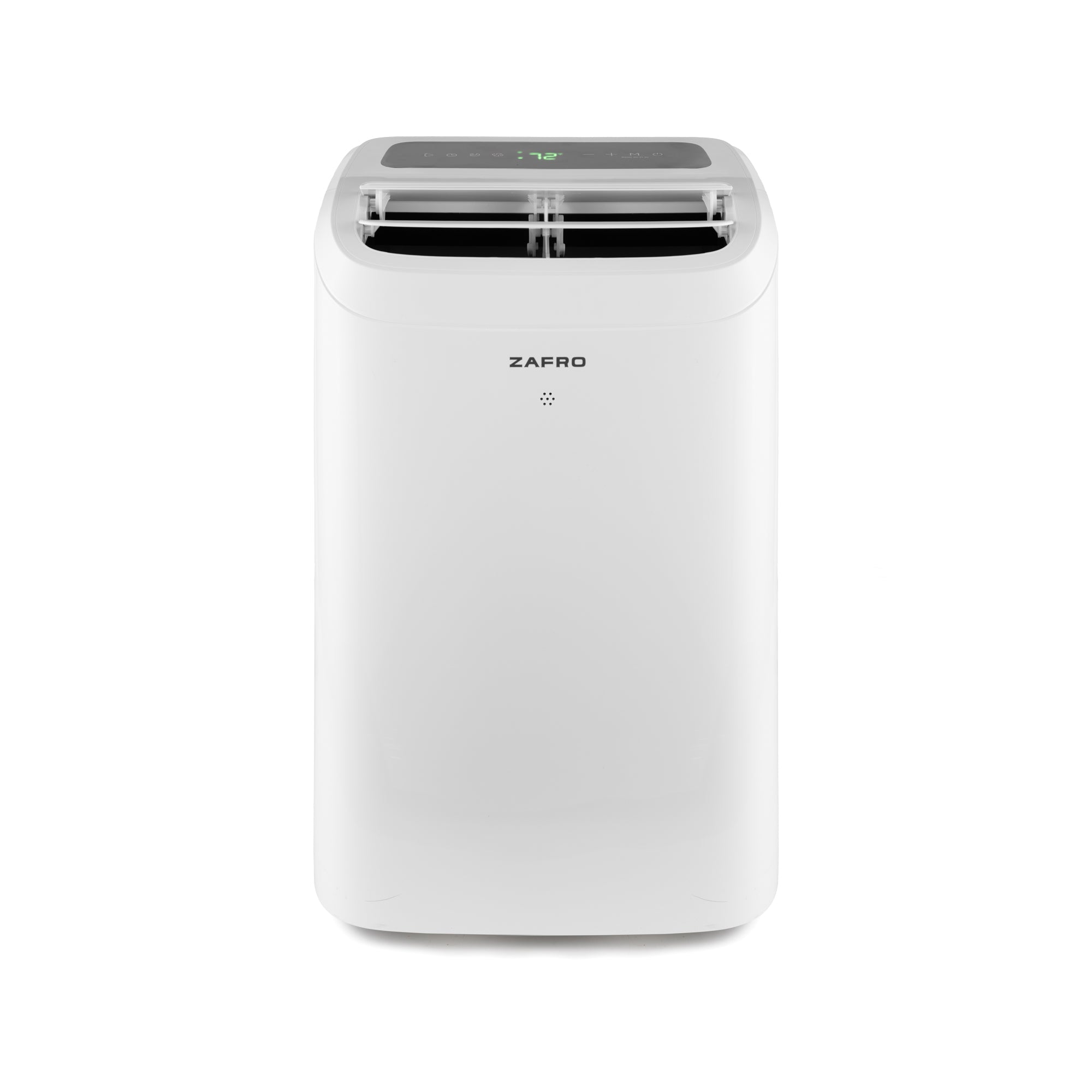
A mini-split earns its cost in a single problem room with no window options. A through-the-wall unit fits renters who want something self-contained and less permanent-feeling. A refrigerant portable makes sense only when neither of those is possible.
The tradeoff is real: higher upfront installation cost buys quieter operation, better humidity control, and smart features that actually get used. Before you buy anything, get a licensed installer to run a proper sizing check against your room’s real load, not a guess based on square footage alone.
— Bassem
Where to Start: Rowan Appliance Ventless Models and Support
Rowan Appliance built the ZAFRO lineup specifically for the problem this guide covers: reliable, ventless refrigerant cooling that doesn’t force you to choose between comfort and a smart-home setup. Every model pairs app-based control with the one-year warranty and direct support Rowan Appliance backs across its full air conditioner collection, so you’re covered well past the install date.

If your space is a single mid-size room, start with the EliteCool spec page. If the unit needs to blend into a living space, check the Bamboo EliteCool instead. For a bedroom or office where quiet operation matters most, the ComfortFlow page has the details you need. Not sure which fits your room? Reach out to the support team of your chosen vendor with your square footage and window situation to get help choosing the right size before ordering.
FAQ
Do Ventless Air Conditioners Actually Work as Well as Window Units?
Yes, and refrigerant-based ventless systems often outperform window units on efficiency and noise once sized correctly. The catch is that performance depends entirely on matching capacity to your room, since an oversized unit cools fast but struggles to remove humidity, according to ENERGY STAR.
How Disruptive Is Installing a Mini-Split or Through-the-Wall Unit?
A mini-split needs roughly a 3-inch hole through an exterior wall for the refrigerant line, while a through-the-wall unit needs a framed sleeve opening sized to the chassis. Both are permanent changes best handled by a licensed installer to avoid moisture problems from poor sealing.
Is the Refrigerant in These Units Safe?
Yes, refrigerant lines are sealed closed loops, and a properly installed system poses no exposure risk to your household. The industry is shifting toward lower-impact refrigerants like R-32 and R-454B, and a professional installer handles all refrigerant charging and servicing.
Can I Control a Ventless AC With Smart-Home Devices?
Most current models, including the ZAFRO lineup from Rowan Appliance, include Wi-Fi control for scheduling, remote adjustments, and voice assistant compatibility. Check the spec sheet to confirm whether smart control is built in or requires an external add-on controller.
What Size Ventless AC Do I Need for My Room?
Sizing scales with square footage, roughly 5,000 BTU for a 100 to 150 square foot room up to 18,000 BTU for 700 to 1,000 square feet, per ENERGY STAR guidance. Adjust upward for sun exposure or poor insulation, and confirm the final number with an installer before buying.